Why Bentonite Cat Litter Is Not as Simple as It Looks
At first glance, bentonite cat litter looks like a commodity product.
In reality, it’s one of the easiest pet products to source incorrectly.
Two litters may appear identical in photos or even share similar specifications, yet perform very differently in real-world use. The difference often comes down to processing methods, raw material activation, and particle engineering.
For private label brands and distributors, understanding these differences is critical—especially when evaluating granular vs spherical bentonite cat litter.
Granular vs Spherical Bentonite Cat Litter: What’s the Difference?
Both types are made from bentonite clay, but the production process defines performance.
*Granular vs Spherical Bentonite Cat Litter – Production Comparison
| Factor | Granular Bentonite Cat Litter | Spherical Bentonite Cat Litter |
|---|---|---|
| Production Method | Extrusion → curing → crushing → sieving | Powder → disc pelletizing (ball forming) |
| Raw Material | Activated bentonite (closer to sodium-type behavior) | Mostly calcium bentonite + soda ash |
| Process Stability | More controlled, multi-step processing | Faster, simpler process |
| Particle Formation | Irregular granules | Round-shaped particles |
| Strength Formation | Built through extrusion + curing | Limited structural strength |
*Granular vs Spherical Bentonite Cat Litter – Performance Comparison
| Performance Factor | Granular | Spherical |
|---|---|---|
| Absorption Speed | Medium | Fast |
| Absorption Capacity | Higher (per weight) | Lower |
| Clumping Strength | Strong, dense clumps | Weaker, more fragile |
| Dust Control | Lower (after screening) | Higher (especially after transport) |
| Transport Stability | High (less breakage) | Lower (prone to crushing) |
| Tracking | Moderate | Lower (due to round shape) |
| Appearance | More premium look | Smooth but less “structured” |
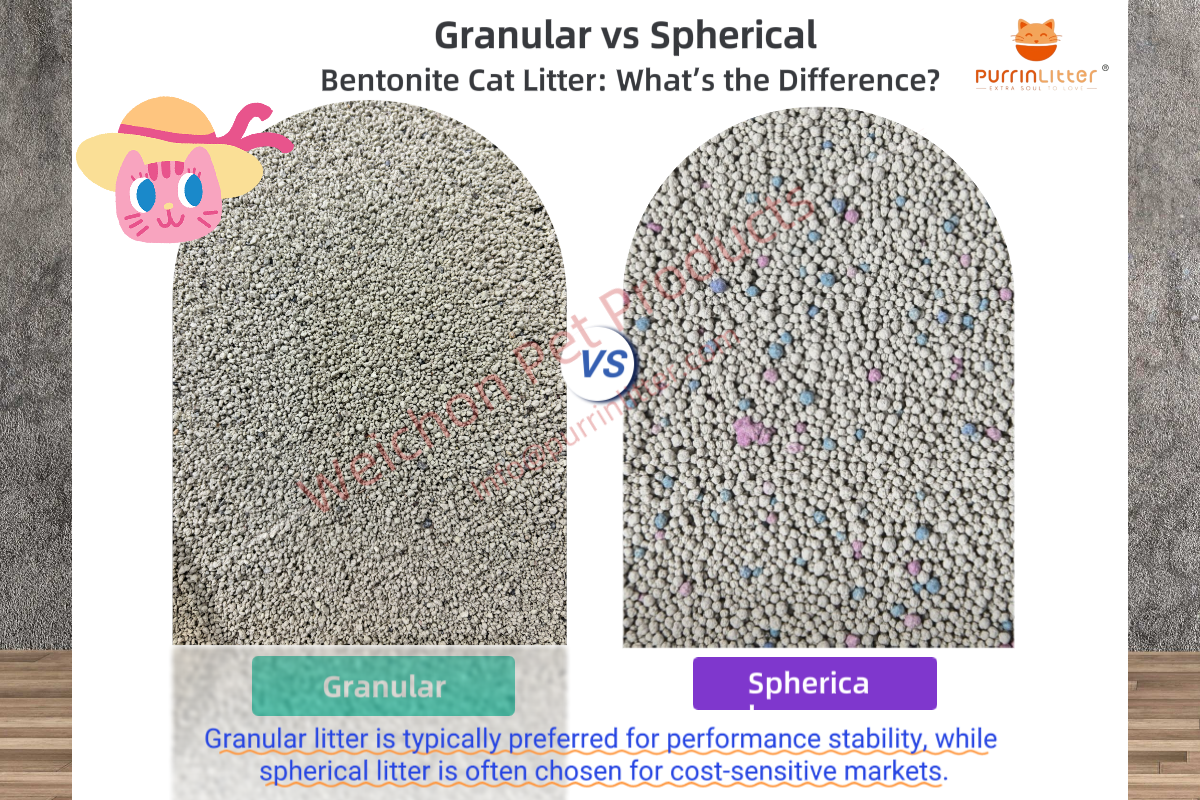
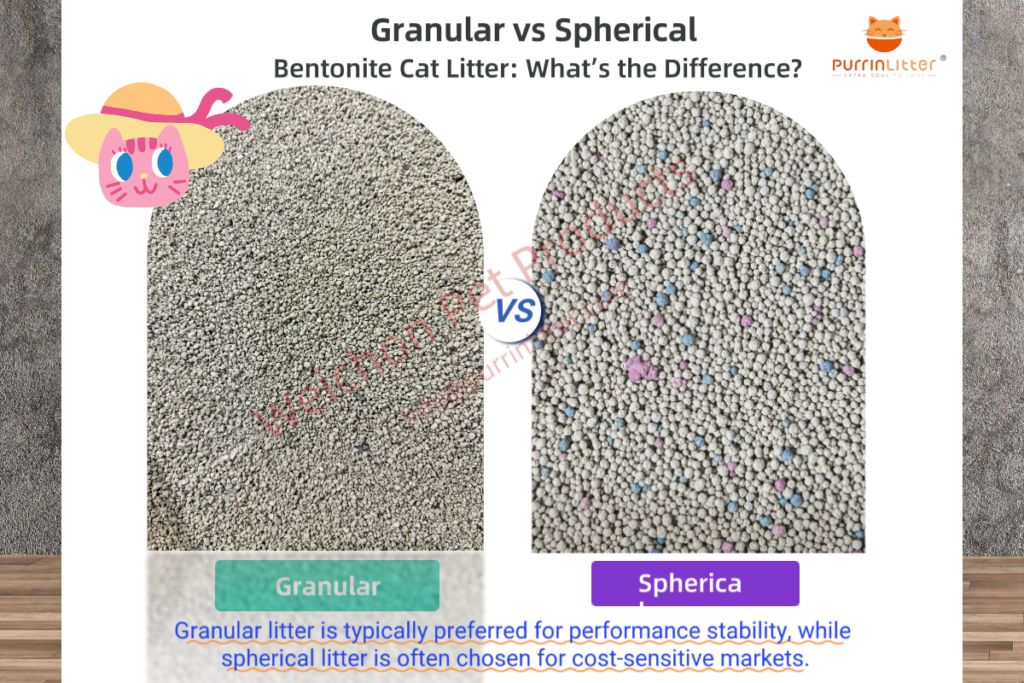
Granular litter is typically preferred for performance stability, while spherical litter is often chosen for cost-sensitive markets.
Why Production Method Directly Affects Performance
For buyers, the key takeaway is:
Clumping performance is not just about raw material — it’s about processing.
Clumping Strength vs Absorption Speed
- Spherical litter: absorbs quickly but forms weaker clumps
- Granular litter: forms denser, more stable clumps
In daily use, strong clumping performance matters more than speed, because it determines:
- Ease of scooping
- Tray cleanliness
- Waste control
Dust Control and Logistics Reality
Dust is one of the most common complaints in bentonite cat litter sourcing.
However, dust is not only a production issue—it is also a logistics issue.
Spherical litter tends to:
- Break under compression
- Generate fines during shipping
- Arrive with visible dust in packaging
Granular litter, due to higher particle strength and screening:
- Maintains structure better
- Produces less secondary dust
- Performs more consistently after long-distance transport
Particle Size Matters More Than Most Buyers Realize
Another overlooked factor is particle size distribution (PSD).
Granular litter allows better control over:
- Size uniformity
- Dust fraction (fines)
- Tracking behavior
Different particle sizes influence:
- User perception (texture, cleanliness)
- Tracking outside the litter box
- Consumption rate
For OEM and private label brands, this directly affects:
- Customer reviews
- Repeat purchase rates
- Brand positioning
Which Bentonite Cat Litter Is Better for Your Market?
There is no universal “best” option.
The right choice depends on your target market and channel.
Spherical litter may suit:
- Low-cost markets
- Price-sensitive wholesale channels
- Short-distance distribution
Granular litter is preferred for:
- Premium retail markets (EU/US)
- E-commerce channels (review-driven)
- Long-distance export (South America, Middle East)
What Buyers Should Focus on in OEM Cat Litter Sourcing
Instead of asking “which is better,” experienced buyers focus on:
1. Clumping consistency
Not just initial performance, but stability over time
2. Dust control after shipping
Not just factory condition
3. Particle strength
Resistance to breakage under compression
4. Batch-to-batch stability
Consistency across production cycles
Because in real markets:Customers don’t evaluate lab samples — they evaluate daily use.
A Practical Recommendation for Private Label Brands
For most private label projects targeting mid-to-high-end markets:
- Granular bentonite cat litter offers better performance stability
- It reduces complaints related to dust and weak clumps
- It supports stronger brand positioning
However, optimization is still required in:
- Particle size
- Moisture control
- Dust removal processes